Ushering in a New Republic: Theologies of Arrival at Rome in the First Century BCE by Trevor S Luke
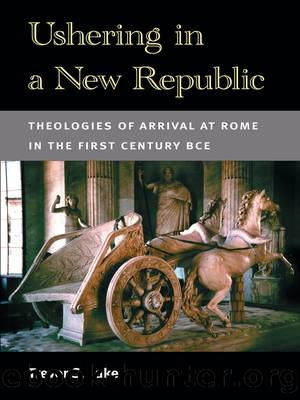
Author:Trevor S Luke [Luke, Trevor S]
Language: eng
Format: epub
Tags: History, General, Ancient, Rome
ISBN: 9780472120383
Google: 1JhFDwAAQBAJ
Publisher: University of Michigan Press
Published: 2014-09-11T20:43:44+00:00
EBSCOhost - printed on 7/30/2022 10:19 PM via . All use subject to https://www.ebsco.com/terms-of-use
PART III
The Res Gestae and the Advent of the Princeps
EBSCOhost - printed on 7/30/2022 10:19 PM via . All use subject to https://www.ebsco.com/terms-of-use
CHAPTER 6
The Res Gestae as Divine Relic
The third part of this book argues that Augustus constructed the first thirteen chapters of his Res Gestae (RG) as an extended arrival narrative. These thirteen chapters serve as an ideological framework for Augustus' arrivals up to 13 BCE, offer a reworking of the memory of Caesar, and provide an interpretive key for select Augustan monuments. Furthermore, the narrative of these chapters alludes to different chronological strata of Roman historyâincluding the regal period, the recent civil war past, and Augustus' own storyâin a kind of palimpsest. Augustus uses allusions to Romulus and Numa to thematize the civic arrivals of this passage in two phases. The arrival events are also connected to a group of predominantly Augustan monuments that form an itinerary ending at the Forum of Augustus. There in the Forum, one sees the culmination of Augustus' career in the image of the triumphal quadriga inscribed with his honorific title pater patriae.1 Through these different devices, the RG presents a unique theological case for deifying Augustus.2
Augustus' decision to allude to Romulus and Numa in the depiction of his arrivals is noteworthy because, in doing so, he largely bypassed recent precedents for associating one's self with peripatetic Greek deities in one's arrival at the city to return to more traditionally Roman models.3 As argued in the last chapter, Augustus became the New Apollo in his return to Rome after his victory in the Sicilian War. Antony fashioned himself as a New Dionysus, particularly in his interactions with eastern cities. Rome had its own tradition of identifying arriving victors with the founders and heroes of the past. Marius was called a founder of the city (perhaps specifically a third founder) upon his triumphal return from his victory over the Cimbri and Teutones. In this way the arriving Marius was connected to the memories of men like Romulus and Camillus. Sulla's arrival and refounding activities were so influential that they subsequently became a model for the arriving savior. Lentulus Sura thus depicted himself as the âThird Corneliusâ in 63.
The RG combines this uniquely Roman tradition with an implicitly euhemeristic argument for the deification of Augustus. The synthesis of these elements is reflected in the final stage of the narrative's itinerary in the Forum of Augustus.4 At the Forum, the emperor's deification is strongly hinted at in the form of a visual theology in which Augustus' quadriga, having reached this final stage of the journey, strategically situates him in a hierarchically arranged gathering of founders, heroes, and gods wherein Augustus is assimilated to the latter. Moreover, the RG induces its reader to re-perform an ideal, imperial arrival at Rome of a divine Augustus, and in doing so, it implicates that reader in an identity shaped by the princeps' historical, political, and theological vision.
Download
This site does not store any files on its server. We only index and link to content provided by other sites. Please contact the content providers to delete copyright contents if any and email us, we'll remove relevant links or contents immediately.
The Vikings: Conquering England, France, and Ireland by Wernick Robert(84384)
Ali Pasha, Lion of Ioannina by Eugenia Russell & Eugenia Russell(40320)
The Conquerors (The Winning of America Series Book 3) by Eckert Allan W(37984)
The Vikings: Discoverers of a New World by Wernick Robert(37007)
Cecilia; Or, Memoirs of an Heiress — Volume 1 by Fanny Burney(32638)
Cecilia; Or, Memoirs of an Heiress — Volume 2 by Fanny Burney(32013)
Cecilia; Or, Memoirs of an Heiress — Volume 3 by Fanny Burney(31997)
Empire of the Sikhs by Patwant Singh(23136)
The Secret History by Donna Tartt(19310)
Hans Sturm: A Soldier's Odyssey on the Eastern Front by Gordon Williamson(18651)
Cat's cradle by Kurt Vonnegut(15446)
Pimp by Iceberg Slim(14679)
Sapiens: A Brief History of Humankind by Yuval Noah Harari(14465)
Norse Mythology by Gaiman Neil(13459)
Talking to Strangers by Malcolm Gladwell(13445)
Leonardo da Vinci by Walter Isaacson(13413)
4 3 2 1: A Novel by Paul Auster(12517)
Underground: A Human History of the Worlds Beneath Our Feet by Will Hunt(12146)
The Radium Girls by Kate Moore(12096)
